
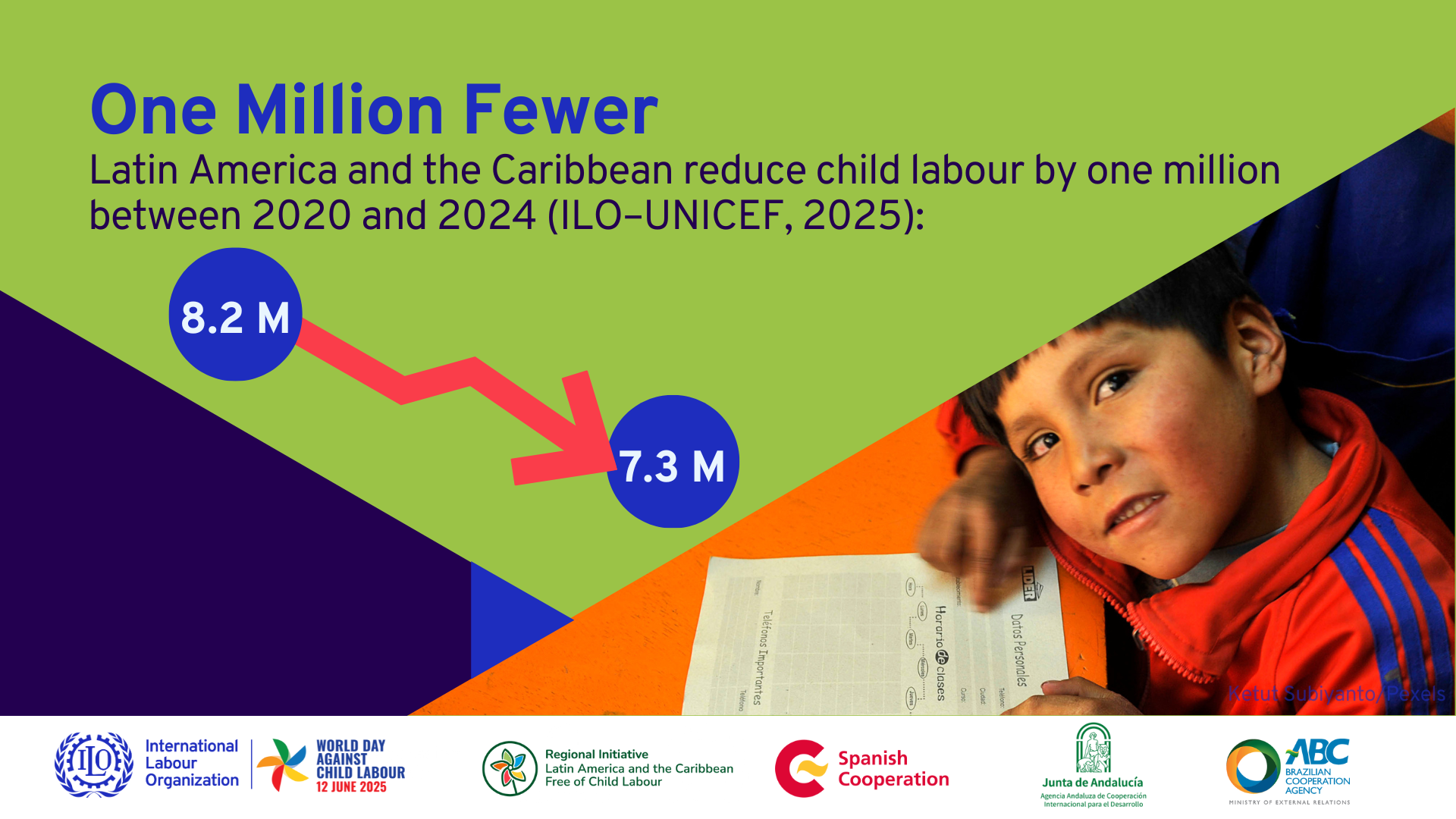
In a complex global landscape, Latin America and the Caribbean marks a new milestone in its fight against child labour: between 2020 and 2024, nearly one million girls, boys, and adolescents have been removed from child labour. The region thus strengthens a trend of over two decades of sustained progress, achieving a 50% reduction since 2008.
This achievement confirms a key truth: when action is collective, strategic, and sustained, change is possible—even in challenging contexts. However, with only a few years left to achieve the 2030 Agenda, the current pace is not enough. There is an urgent need to accelerate efforts with political will, technical focus, and coordinated action.
"Twenty years of sustained progress show us that eradicating child labour is possible. But to reach 2030, we must do more, do it better, and do it together,” said Pilar Rodríguez, ILO Regional Coordinator for the Regional Initiative Latin America and the Caribbean Free of Child Labour.
Challenges that demand specific and ambitious responses
Despite progress, critical hotspots remain that require targeted interventions. Hazardous child labour is concentrated in adolescents aged 15 to 17, who represent 61% of those affected, while 800,000 children aged 5 to 11 are engaged in dangerous tasks. Among girls aged 12 to 14, the rate of child domestic work is twice as high as the overall child labour rate for this age group, shedding light on a reality that has long been hidden. In addition, nearly half of working adolescents are not enrolled in school.
These figures not only highlight the remaining challenges but also point clearly to where and how to act. Sectors such as agriculture, territories with high prevalence, and vulnerable groups like child domestic workers require targeted and tailored responses.
The Regional Initiative: coordination, strategy, and real impact
In the face of these realities, the Regional Initiative Latin America and the Caribbean Free of Child Labour has positioned itself as a key platform to accelerate action. Comprising 31 countries, it brings together efforts from governments, employers, and workers’ organizations, in coordination with international agencies and civil society, to transform data into decisions and decisions into impact.
Innovative tools such as the Child Labour Risk Identification Model (CLRISK) help target policies, interventions, and resources where they are most urgently needed—by age group, sector, and territory. This capacity for technical and territorial precision has been crucial in driving current progress.
The Regional Initiative also fosters strategic partnerships and promotes the integration of child labour as a cross-cutting priority in development agendas, national budgets, and social programmes.
A possible goal, a shared responsibility
Although the road ahead is demanding—the region must accelerate the current pace of reduction elevenfold to meet the 2030 goal—results show that acceleration is possible. The key lies in advancing more ambitious, visible, and sustained initiatives.
Now more than ever, eradicating child labour is not just a commitment to children—it is a pledge for a fairer present and a future of real opportunities for the entire region.
👉 Learn more about the global estimates:
https://www.ilo.org/resource/news/despite-progress-child-labour-still-affects-138-million-children-globally
Comentarios